
Why Geese Did Nothing* Wrong
Or: Cultural Hegemony and the Banality of the Evil of Marketing

Even before news of their viral marketing psyop hit the Substack wire, Geese were a marmite band.
You either loved them or you wanted to smash them to a pulp and spread them on toast.
Don’t Believe The Hype
When I first listened, the hype put me off.
I’d seen so many people talking about them all over the Internet that I rebelled against this consensus and decided that they must be shit.
It turns out that this consensus may have been manufactured.
The Fanfare Around the Band Geese Actually Was a Psyop
From the article:
Essentially, the firm creates networks of social media pages (typically on TikTok) and uses them to drive the band’s music into the recommendation algorithm. Songs are dropped into the backgrounds of videos. Live clips are shared. Sometimes, burner accounts, comments, and whole ecosystems of interactions can be fabricated out of digital cloth, stoking—and in some cases, completely manufacturing—discourse around an artist.
Basically, giant bot-farms of fake fans.
Being generous, you could call this marketing. An aggressive form of marketing constructed on a throne of lies, sure, but nothing more.
Being ungenerous, you could say that this agency has built a giant social media Truman Show and put all of us inside it to sell music.
Being generous again, you could say that the Truman Show they built is far less nefarious than the ones built by the social media companies and state apparatus to rig elections and foment civil unrest.
Marketing has always been built on misdirection and the activation of automatic responses - for example:
Here’s an actor who played a doctor on television.
He is selling (advertising) some medicine.
He must be trustworthy, because he was a doctor on television.
Please let me have some pills.
Eventually, we cotton on to the trick du jour, and the ad agencies have to find the next one. Perhaps bot farms and fake reviews are just another trick we’ll have to become literate in. Actually, that’s almost guaranteed now. It’s probably already happening in myriad industries - this trick is too good to be the sole reserve of the arts.
The original scoop came from a Substack (below), subtitled ‘the digital marketing agency that creates your music taste’

Payola
I’m going to be generous to the marketing agency again, for a third time (I don’t know what’s gotten into me) and say that there were always marketing agencies creating your music taste. There were always PRs and agents calling up magazines and getting their buzzy new boys (for whom they had created the buzz) on the cover of the NME or Kerrang or whatever. Slipping a cheeky £20 to a radio DJ to get a song prime airtime.
And actually, I’m going to be generous for a fourth time - I’d rather have human beings making decisions about who to market, rather than an algorithm which cares about nothing more than making the most money, and which thinks that the easiest way to do this is to play it safe and give you what you already like.
Although I suppose in this case it’s a human being directing an algorithmic entity, so I’m going to retract the fourth instance of generosity.
You Can Be Free And Still Come Home
Some people are viewing this marketing campaign as a vindication of their long-held beliefs that Geese are trash, like this Substack.

The thesis of this piece is that no one actually likes the music they’ve been told by marketing to like. And this is half of a good thesis.
But it doesn’t explain the feeling I get when Cameron Winter screams this absurd verse from Au Pays Du Cocaine.
Like a sailor in a big green boat / Like a sailor in a big green coat / You can be free / You can be free and still come home
This might be an idealistic way of looking at things, but I think a bad song that’s marketed well will still be thought of as a bad song. For example, Friday by Rebecca Black.
A good song that is marketed badly is a song that no one will ever hear. This is an unfortunate truth, but it is the way of things.

The Pre-Eminent Satirical Novelist of His Generation
I’ve written four novels, and I think that three of them are good enough for consideration by traditional publishing, but I haven’t had any luck with literary agents.
There is a Substacker I’ve argued with who wrote a post about how he thinks that literary agents don’t even read query letters, but I think that this is mostly nonsense.
However, it is undeniable that having a bigger social following is very likely to bump you up the slush pile. So if I did as Geese have done and hired the Chaotic Good Marketing Agency to make a bunch of TikToks about how Joseph Kilvington is the pre-eminent satirical novelist of his age, would that be enough to get me a book deal? Who knows, but my chances would almost certainly skyrocket.
This idea, that selling oneself is inherent in the process of having sold something, tramples over the supposed sanctity of making art for art’s sake, but to ignore it doesn’t do a favour for anyone. I’ve seen loads of novelists complain about how they have to market themselves, and how this is a job in itself, but the reason they are complaining about this is not because there was no one doing the marketing in the good old days; it’s because there was someone else doing it. A marketing agency. Like the one Geese hired.
Nowadays, to get ahead in the book game, you have to self-market. Geese added a middleman into the equation. That’s all. Well, not really. They added a thousand shapeshifting mind-controlling middlemen. But this is merely because that’s what they needed to do in order to get noticed.
Because everyone else in the industry is busy selling the twenty-fourth re-release of the Taylor Swift vinyl.
The Twenty-Fourth Reissue of the Taylor Swift Vinyl
Spotify and the other streaming services have taken over the music industry. In 2025, Spotify held a 47% market share of UK streaming subscribers, with Amazon Music in 2nd with 26.9% and Apple Music in 3rd with 19%. Not going to lie, I guess I knew that Amazon had a music division, but I’d assumed it was relatively small.
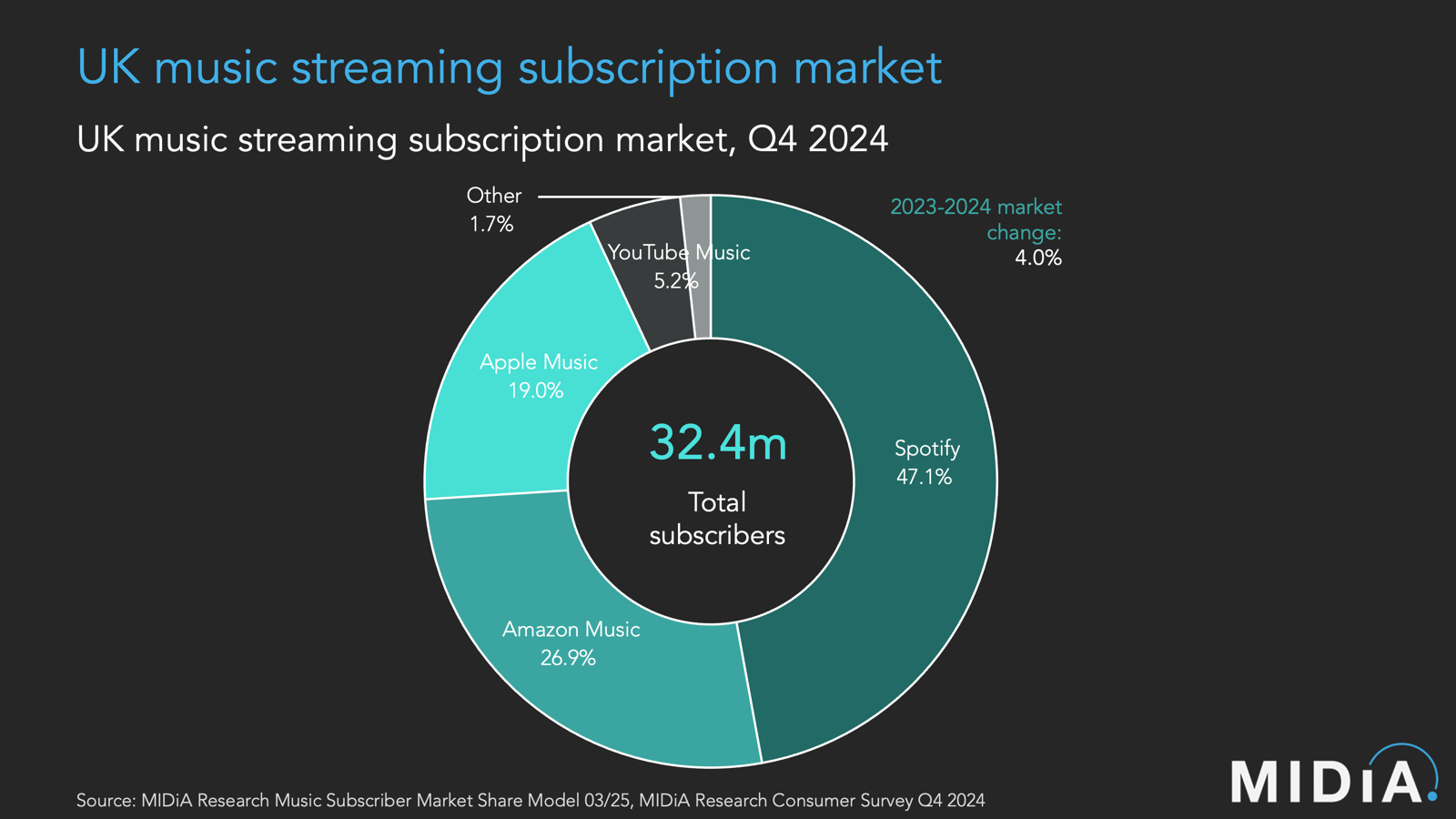
Anyway, none of this is new information to you. We all know that no one buys music now. We pay Spotify, and in turn, they pay artists a pittance.
My most-played artist since 2013, when records began (that’s my personal statistical records, I’m not saying that the concept of the album only began in 2013), is Arctic Monkeys. I’ve listened to around 4,000 songs of theirs in that time (on iTunes, which is where I still mostly listen to music). According to this stream calculator, that would be worth £15.
My total number of plays is 126,000, equivalent to £484. Spotify cost £10/month for most of the time since 2013, so had I been a Premium subscriber for the duration, I’d have paid £1500, meaning 33% of my money would have gone to the artists, which is actually a higher percentage than I’d have thought.
Let’s Get Physical
In 2006, the year I bought my first CD, 152 million physical albums were sold in the UK.
The total revenue from recorded music (again for the UK) was just over £1 billion, down from a peak of £1.23 billion in 2001.
In 2024, the figure was £1.49 billion, with streaming alone accounting for just over a billion. Physical media still accounted for £247 million, with K-Pop and Taylor Swift driving a recent resurgence in CD sales (one of the reasons Taylor Swift contributed so much was that she released four different CD versions of The Life of a Showgirl).
If we adjust the 2006 figure for inflation (£1.75 billion), this is a reduction of 15%. Which is far less than I thought it would be. In an earlier version of this, I’d done some dodgy calculations and come up with a 90% reduction, which gave me the perfect narrative for the story I’d been writing about the money in music having disappeared. But it doesn’t seem that this is the case.
However, when you break down these numbers by artist, things get more interesting. A 2020 study showed that 90% of all streams go to 1% of artists. This is a global study, and six years old, but if things have changed, I would imagine it’s only been to concentrate streams into an even smaller elite.
Let’s go back to 2006 to see how (if at all) things were different.
Snow Patrol had the best-selling album in the UK, with Eyes Open. It sold 1.5 million copies, around 1% of the total album sales. The top 50 artists sold a combined 31 million records, about 20% of the total, so not as top-heavy. Streaming obviously counts all previously released music too, but all this does is further consolidate things at the top.
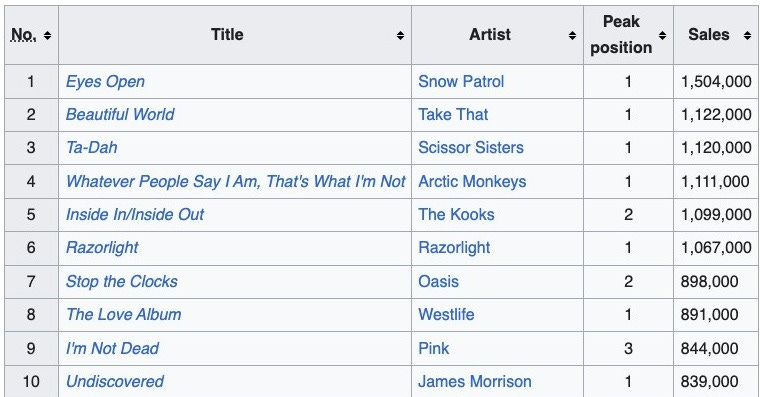
Again, this is not a novel observation, but I think it’s helpful to put it in numerical terms.
Gross Domestic Product
I once got into a Twitter beef with the author John Green (by which I mean I replied to one of his tweets snarkily and he hit me back, also snarkily) when he was bigging up GDP growth as a barometer of social progress. My point was that this isn’t necessarily a proxy for ordinary people having better lives, because money is increasingly being siphoned upwards into the hands of the few.
So, while a 15% reduction in total revenue doesn’t seem that bad, the concentration of that revenue in the bank accounts of an ever-increasing few paints a less rosy picture.
Last year, British indie stalwarts Field Music announced that they were forming a Doors tribute band called The Fire Doors. In their own words:
Why are we doing this? Making a living from making our own music has become increasingly difficult. We need other income streams
This is a band who have released three top 40 albums and have been touring for 20 years. Millions of streams on Spotify. That should be enough to make a living, but it isn’t any more.
The next stage is the why behind each component. Why has it become difficult to make a living from original music? Well, for one, it's always been difficult. But where we used to see a lot of casual record buying — how many of you spent a tenner on a CD back in the 90s and only ever listened to it once? — we now have a streaming culture where casual listeners get the same experience but without wasting that cash (which inadvertently subsided thousands of smaller artists.) Streaming also funnels attention and money to the top, the middle class of record makers either fights to get to the top table (by making music which fits the streaming paradigm) or gets a real job.
They go on to say that they feel no embarrassment at doing this (nor should they), but it is clear that money was a motivating factor.
Kate Nash, who had a number one album in 2007, recently spoke to MPs about how she had lost £26,000 on her latest tour of Europe. By contrast, Taylor Swift’s Eras Tour grossed $2b, which amounts to a profit of roughly $5.5m per show, according to this blog.
One way of combating this capitalistic concentration is to buy music on Bandcamp, which offers a way of paying more reasonable amounts for albums, and a more reasonable cut for the artists, but it is very hard to justify £10 on a single album (which you might not even like) when you can get every album ever made for the same price. People also have less money than they used to, which makes it even harder to justify the cost.
Personally, if I could buy every album on Bandcamp for a fiver, I’d probably do it, but it will take a lot for the average listener to unlearn the convenience of streaming.
Cultural Homogenisation
This funnelling of profits upwards isn’t limited to music.
Substack loves it when a celebrity with an existing following comes along because they have loads of baked-in subscribers. So they are already at an advantage.
Likewise, Spotify loves existing megastars because it knows they are safe bets for making megabucks. Film studios love existing IP because it is perceived as less of a risk than something new. Remakes, reissues, rehashing, repackaging.
The twenty-fourth reissue of the Taylor Swift vinyl.
Every coffee shop with the same font. Every book with the same cover. A McDonald’s on every corner selling the same Big Mac in Boston, Brasilia and Beijing.
In the short term, we are happy because we are getting what we want, which is what we know. It takes less effort to engage when you don’t have to think about whether or not you like something. But in the long term, there is a cost. Lack of innovation, lack of creativity. Lack of originality.
Lack of the new.
Don’t Hate The (Music) Player, Don’t Hate the Game
The dominance of streaming is also important because of the role that these platforms play in the discovery of new artists. They use data, and lots of it, to try to predict exactly what it is we will resonate with. But, and as is the case with any kind of algorithmic predictions, these are only as good as the assumptions underlying them.
To get people to listen to you, you have to play the game. Social media followers, cross-promotion, hype. As the linked article says:
If you want it to notice your music, you need to implement a Spotify strategy, create hype in the run up to your release date and develop some genuine momentum.
Not to say that Spotify and its ilk never recommend different things. I found the song Dizzy on the Comedown by Turnover (a certified 10/10 banger) on a Discover Weekly playlist in 2017. And there is definitely a pathway to discovery through playlists like that these days (though, as I said, you have to be willing to play the game). But when 1% of artists hoover up 90% of the streams, it is clear which music is being pushed the hardest.
I’m trying my best not to come across as an old man yelling at a cloud. Because all I’m doing is describing pop music, isn’t it? There is always going to be someone at the top (and if she has her way, then that someone is always going to be Taylor Swift).
There is always going to be pop music which is listened to by a majority of music listeners (or at least, under a system with either human or algorithmic gatekeepers, it will always exist. Not that there could be a system entirely without influential gatekeepers of some kind. There is a study (I can’t find it, but it was mentioned in Influence by Robert Cialdini) which showed that we perceive music to be better when we think that it is liked by other people.
So, even in a 100% meritocratic system, with 100 songs of exactly equal excellence being rated by neutral listeners, a hierarchy would still emerge, so long as each subsequent voter was able to see the votes of the previous voters.
But, and here we reach the point I’ve been trying to make for a while - convergence is a net negative for any creative industry.
If all you can get is more of the same, then you lose the ability to be shocked by something. And the worst part is that we wouldn’t even know that we were missing out on something, because there wouldn’t be anything left for us to be missing out on, like a child walking through the abandoned wasteland of what used to be a majestic forest, looking at a plastic bag tangled in the lone remaining bush, thinking that nothing is out of the ordinary.
I’m not saying here that there isn’t a plethora of incredible music out there right now. There is. This isn’t a ‘music was better in the 70s’ type discussion. I’m saying that if we continue to follow the orders of our algorithmic overlords, then the only artist we’ll be able to listen to will be Taylor Swift (who actually ranks 17th on my all-time most-played artists list, for what it’s worth). And not even Swifties want that, I’m sure.
This is, of course, a hyperbole. But it is an exaggerated endgame for a scenario that is already playing out.
We are not obliged to have all of the amazing music we currently get. As Field Music and Kate Nash show, when making music that people like is not enough to make a living, some of these musicians will have to stop making music.
And this won’t happen quickly. As John Green said of falling in love, it will happen slowly, then all at once.
People will still form bands. But Spotify will further concentrate streams into the hands of the megastars, so there will be fewer opportunities for people to break out. There will still be magazines and radio shows playing music from outside the mainstream, but most people listen to what is easiest, so if more people are listening to the stuff being pushed by the streamers, then there will be even less left at the table for the rest of the artists.
People will still listen, but fewer people. So these bands can’t afford to make a living. Can’t afford to tour. So they stop making music, and someone else defaults to the Spotify Top 40 because their favourite band called it quits.
Timothee Chalamet got into a lot of trouble during his Oscars campaign for comments he made about ballet and opera:
“I don’t want to be working in ballet, or opera, or things where it’s like, ‘Hey, keep this thing alive, even though like no one cares about this any more’”
But he’s not wrong about one thing - opera and ballet are not the giants of mass entertainment that they used to be. Imagine quoting Timothee’s comments to someone at the Rite of Spring riot in 1913 (very pleased with this reference). They wouldn’t understand what you were talking about (and to be fair, they’d have bigger things to worry about pretty soon). The point is, ballet used to be huge. It got replaced.
But ballet was replaced naturally. People liked something else and moved on. That happens. It won’t be the same this time.
Unless we fight for musical variety, we might just be left with the same ten faces on the Spotify carousel, revolving over and over until the day we die.
The Pre-Eminent Substacker of His Generation
When I joined Substack, as was the case when I joined Medium before that, I had the naive belief that the readers would come to me. That the quote-unquote ‘quality’ of my writing would be enough to bring the subscribers rolling in. But that’s not the case.
Everything is a game here, too. Following other accounts, interacting with posts, posting notes, reposting articles, constantly selling the idea of why people should give you their precious email address, because the writing is not enough.
And if this all sounds a bit ‘poor me’, then it’s not supposed to. I understand that in the days before the Internet, there were still gatekeepers. That before the blog, there was nowhere for an unknown writer to even have the chance that someone might read what they had to say, unless they lucked their way into an article at a legacy publication. That before Spotify, there were still industrial tastemakers and marketing departments and major labels, and that getting a record deal was pretty bloody difficult.
The difference, then, is that there were still people involved. The algorithm would autoplay until the end of the world if you gave it a chance. Everything is automatic. There is no one choosing what to suggest, and you are not choosing either. We are no longer individuals; we are cogs in a machine which has so far paid Daniel Ek 8.7 billion dollars. Netflix autoplays the next episode of the show which it autoplayed when we finished the last episode of the previous show it had autoplayed.
So what have we established? That to be successful, you have to be both good and well-marketed?
Let’s take a trip back in time.
My first MP3 player had four albums on it. A far cry from what’s available on Spotify.
There were probably more, if I’m being honest, but the ones I can remember listening to on repeat were:
Whatever People Say I Am, That’s What I’m Not, by Arctic Monkeys
Alright Still, by Lily Allen (the first album I ever bought, after watching her on Jools Holland’s Hootenanny, 2006)
Buck Jump, by the Dirty Dozen Brass Band
Hotel California, by The Eagles

The MP3 player itself was a gorgeous, tiny cube with a unique design, unlike anything you would see today, now that music players have become phones, which have all converged into the exact same shape.
There was also a 39-second snippet of a song, which I have never been able to find the whole version of. Someone in my swimming squad had it set as their ringtone, and they Bluetoothed it to me. I’ve just spent another fruitless twenty minutes using ChatGPT to try and find the song, like a personal AI version of the Case of the Missing Hit, but no dice (it had the line ‘money, money, money’ I think. But it wasn’t Price Tag by Jessie J, or Money, Money, Money by Abba)
I loved that MP3 player, and loved those four albums (all of which are still certified bangers. The DDBB one has a song called Run Joe, which may have endeared it to me, and there is an incredible trombone solo on the opening track, which certainly did). But those were the only four albums I ever listened to of my own accord. Everything else was on CD in the car or on the radio.
Citizen, Erased
Until I met Jason. Nowadays, he is the ultimate music hipster, but when we were eleven, he was very into Muse. Knowing only Arctic Monkeys, Lily Allen and The Eagles, I thought that liking Muse was enough to make him a hipster then, too.
He introduced me to the screeching guitars and wailing vocals of Matt Bellamy, and I was hooked. When The Resistance came out in 2009, I was obsessed.
This obsession peaked when I listened to the song Exo-Politics on repeat for the duration of a two and a half hour bus journey back from a maths tournament in Glasgow. When you listen to the same song on repeat for two and a half hours, you enter a kind of trance, a meditative state I may have also been subconsciously seeking when I listened to Biffy Clyro’s Born on a Horse for a full day when studying for a chemistry exam, or The Stereophonics Have a Nice Day for eight hours while finalising my Master’s dissertation.
We finished mid-table in the maths tournament, despite only arriving halfway through due to a broken-down bus. I flatter myself that I was part of the reason for this, but I was merely one quarter of a team which also comprised a maths prodigy who had been going to University classes since he was about 12, so he probably had more to do with it.
As we got back into Aberdeen, I remember being very annoyed that I was going to have to walk through Union Square, the newly built mega shopping centre next to the bus station. My mum and I were boycotting it for unremembered reasons (perhaps something to do with the convergence of the shopping experience), so my Exo-Politics binge clearly hadn’t quite manifested a truly zen-like state of acceptance.
Over the years, Jason introduced me to so many more artists and sent me so many albums that it would be impossible to list them all here, so I’ll just give you a flavour.
Cardinal, by Pinegrove (one of my all-time favourites, by probably my favourite band. Feels childish to have a favourite band when you’re thirty, but I’m going to fight through the cringe).
Antisocialites, by Alvvays.
In Time to Voices, by Blood Red Shoes (their song Cold was another which I attempted to trance out to. Also, the first gig I ever went to, with Jason of course).
The Art of Forgetting, by Caroline Rose.
Juillet, by En Attendant Ana.
Disparitions, by Jonathon Personne.
Crushing, by Julia Jacklin.
Romance is Boring, by Los Campesinos (Jason’s old Twitter handle).
I could keep going forever, but I’ll stop there. If everything but the Pinegrove had been shit, it would have been worth it, but there are countless bangers in my collection courtesy of him.
One of my favourite things to do when we were in school was to pretend that I had introduced him to Muse. It must have annoyed him one time, so I kept on doing it (this repetitious style being a key tenet of my comedic persona).
I would like to take the opportunity here to clarify for posterity that it was indeed he who showed me the hysterical light.
The 100 Greatest Albums of All Time
For Jason’s 30th birthday, I made a list of my favourite 100 albums of all time, and he has promised me a return list (which I have yet to receive, despite the fact I’ve been 30 for more than six months). I can’t remember what was on my list because I wrote it on a piece of paper, which he now has. Should probably have made a copy.
Anyway, he hasn’t completely flaked out on me - I got a sneak preview of five albums, plus three of the best from 2024, before I went interrailing last year, so today’s essay was going to rank and review these eight albums. Or at least, that’s all it was supposed to be, before I got sidetracked by Geese.
AIA: Alien Observer - Grouper
Ambient music. Another of Jason’s loves. Not sure it’s one of mine. I do enjoy hypnotic, repetitive stuff from time to time. Hypnotic, repetitive stuff from time to time. Hypnotic, repetitive stuff from time to time… But I like my hypnorepetition to have a bit more bounce and melody than this. It doesn’t draw me back in, grab my attention, but then I suppose if it grabbed my attention too much, it would no longer be ambient. Also, and not to dunk on Jason too much here because clearly he has great taste and lots of the stuff he likes I also love, but I don’t get how this can be one of the best albums ever. It’s nice enough, sure, but what sets it apart?
I watched Bottoms the other day, and there are some incredible jokes. But I only rated it a 70%, because for me, I need more than one great element to make a film a classic. So for a comedy to be truly great, it needs to also be something else too. Likewise, for an ambient album to be an all-time great, it would need something else too. And I don’t really get that from this.
The Law of Things - The Bats
Agreeable jangle pop which reminded me of The Beths. Perhaps I should say that The Beths reminded me of this, but that wouldn’t make sense since I heard The Beths first. Perhaps I should actually say that maybe the Beths were inspired by these guys, considering that they are both from New Zealand. There we go. Very modern-sounding record from 1990. I also just realised that the Beths were almost certainly inspired by the Bats, given that they have basically the same name, especially when you say it in a Kiwi accent.
Diamond Jubilee - Cindy Lee
A project from the former lead singer of Women, another band on this list. Two hours is a stretch too long for my liking, but there are some excellent screeching bangers on this. One where I should maybe construct an alternative track listing featuring twelve of my favourites from the twenty-four and listen to that, because it would probably slap.
Rong Weicknes - Fievel is Glauque
Once again, Jason hits me with some music the likes of which I have never heard before. Took me a few listens to get into this, but it goes hard - piano and saxophones getting up to absolute mischief. And the band is named after Fievel from An American Tail, one of the best animated films of all time.
Night Palace - Mount Eerie
I had previously only heard of Mount Eerie, which is the moniker of solo musician Phil Elverum, with respect to the album A Crow Looked At Me.
That album is about his wife’s death, and I have seen it consistently described in ways that have made it impossible for me to listen to. Having not listened to it, the closest comparison I can come up with is Benji by Sun Kil Moon, an album I have only ever managed to listen to three times. The Pitchfork review states that ‘There are 11 songs on Sun Kil Moon’s astonishing sixth LP Benji, and in nearly all of them, somebody dies’, which is an accurate description of how the album makes you feel.
So I was very surprised when I listened to this new Mount Eerie album to find it propulsive and groovy.
Marquee Moon - Television
There was a Twitter blog called Ruth and Martin’s Album Club, which got guests (initially friends of Ruth and Martin and then celebrities) to review great albums from history which they’d never heard before. Martin would write a review, then the guest would write their own, after listening to it at least three times.
Marquee Moon was one of the albums on that blog, and I remember listening to it once and not really getting it. But I failed to follow the rules of the blog, so I never really gave it a proper chance. However, listening to it on more than three occasions this time, I still don’t really get why it is so universally lauded.
I also don’t get why Geese are often slagged off as a poor imitation of Television, because to me, they sound nothing alike.
Public Strain - Women
The other record by Cindy Lee, and this one is much more ambient adjacent. As we have already discussed, if an album is going to be this relaxed, it needs to be special, and I don’t think this one is. Some nice melodies from time to time, but mostly droning, hard-to-focus-on songs.
Deceit - This Heat
Let’s end with a good one. Repetitive and driving but on the right side of boring. Who knows why some things end up on the boring side and some on the good side? Clearly, Jason has a different line of boring to me, and that’s okay. This is quite similar to the Women record, but way more engaging and interesting to listen to.
Boom, and that’s eight albums down the hatch. 5/8 I liked, which is actually quite a low ratio for Jason’s suggestions, but not a bad score.
And he’s forever in the good books for sending me Cardinal by Pinegrove anyway.
The Algorithm As Tastemaker
Everyone should have a Jason. But I fear that most people don’t. I fear that for most people, their Jason is the algorithm.
And when the algorithm is content to feed us the same stuff over and over again because that’s the safest way to make the most money, you can see why Geese took the steps they did to sidestep it. Even if they did so in the creepiest post-modern way imaginable.
Jeff Bezos recently sacked all of the book critics at the Washington Post because he reckons that data does a good enough job of selling books.
If Geese had left it to the data, where would it have landed them?
I Just Wanna Be One of the Strokes
It’s not just the data they’re fighting against. To quote from the above Tony Price article, “[Geese] don’t sound like The Strokes.”
I agree with this. I also love The Strokes. Watching Julian Casablancas muse at a Glasgow seagull was an all-timer of an experience. But the father of their guitarist was already a famous musician. This is clearly different to the Geese psyop, but is it conceivable that no one would have ever heard of The Strokes if it wasn’t for this fact?
To quote Phoebe Bridgers:
“The Strokes are an industry plant – literally! Everybody knows that, at least in music, but it’s never made anyone like them less. It’s such an insane fucking double standard. If you have wealthy parents, you’re not allowed to make music as a woman, but you’re rewarded for it as a man. Every white boy who is mediocre is an industry plant by that standard”
It also doesn’t mean that the Strokes are bad. To get idealistic again, there are plenty of nepo-baby bands who don’t make it. In an even more idealistic world, some of the nepo-baby bands who do make it might be replaced in a meritocratic music landscape by some nobodies.
Alright, Still
You can have advantages and also be incredible. The two concepts are inextricably linked. The advantage is what makes them great, in some cases. Look at Max Verstappen.
Or look at Lily Allen. The daughter of a famous actor. Neither Lily Allen nor the Strokes needed to engage the services of a viral marketing agency because they were already in the game.
Arctic Monkeys made their own viral marketing campaign in 2006. I first heard of them because they were going stratospheric, thanks in part to the fact that they handed out free CDs at gigs. My Dad’s mate gave us a copy at Cambridge Folk Festival, and it made its way onto my first MP3 player.
The Eagles were created by a record company!
I don’t know how the Dirty Dozen Brass Band came to the big time (AKA my MP3 player), but with trombone playing like that, I don’t want to cast any aspersions on them. I’m a trombone player, if that wasn’t clear. I’m sure the whole piece makes more sense now.
And this is where we come full circle. Even Geese - my beloved Geese - are not immune from these accusations of nepotism. Lead singer Cameron Winter’s Dad is a composer, so does that render this whole essay moot? I don’t think so.
I’m going to say that if industry connections aren’t even enough these days, if even nepo babies are having to resort to deceptive marketing ploys, then we’re further along the race to the One Final Artist than I thought.
Coda
Let’s wrap this baby up - what have we learned?
Marketing is, marketing was, and marketing will be.
The algorithm will continue to converge until there is only one musical artist left.
Unless we stop it.
This, then, is why we all need a Jason. A trusted recommender of art which would otherwise not have found its way to you. A shield against the vices and vagaries of the algorithm and the profit motive.
But we can’t leave it all to Jason. We need to pay for music. We need to put a stop to the automatic processes that feed the conveyor belt directly into our brains. Make the effort to hunt out something new, something strange. Send it on to someone else.
Because Jason is very good, don’t get me wrong, but he’s also really into ambient music.